
The staking landscape at a glance
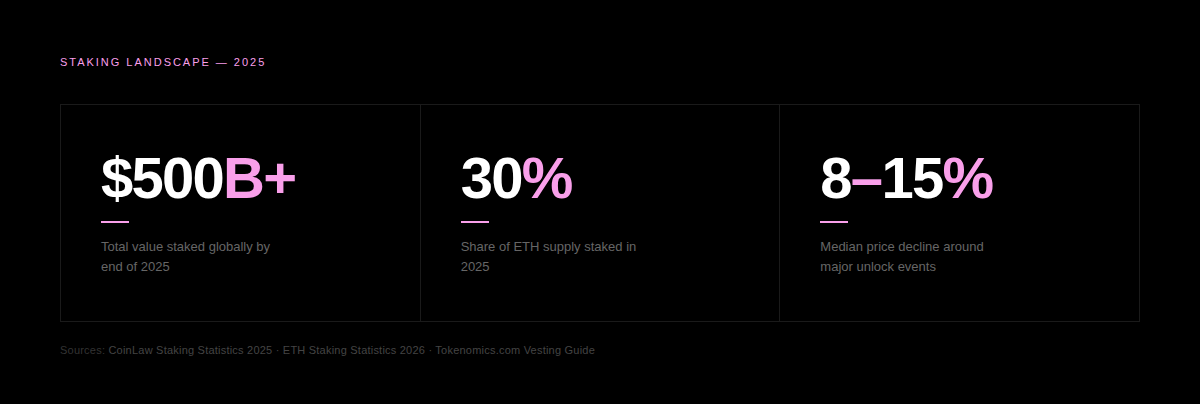
Staking has become one of the primary ways crypto projects engage token holders, reduce sell pressure, and create utility beyond speculation. But while teams focus on the launch announcement, the real work starts after tokens are locked.
This guide covers everything you need to know about staking pools: what they are, why projects use them, how to structure rewards, and what it actually takes to run a staking program long-term.
What is staking?
Staking is when token holders voluntarily lock their tokens for a set period in exchange for rewards. Unlike vesting (which gradually transfers legal ownership), staking is opt-in. Holders keep ownership of their tokens but temporarily restrict transferability to earn yield or other benefits.
Projects use staking for different reasons:
- Proof-of-stake networks need it for economic security
- Token projects use it to encourage long-term holding
- Communities use it to drive on-chain engagement
For most teams, the challenge isn't the concept. It's the operational reality of managing reward distribution, pool parameters, and user flows over months or years.
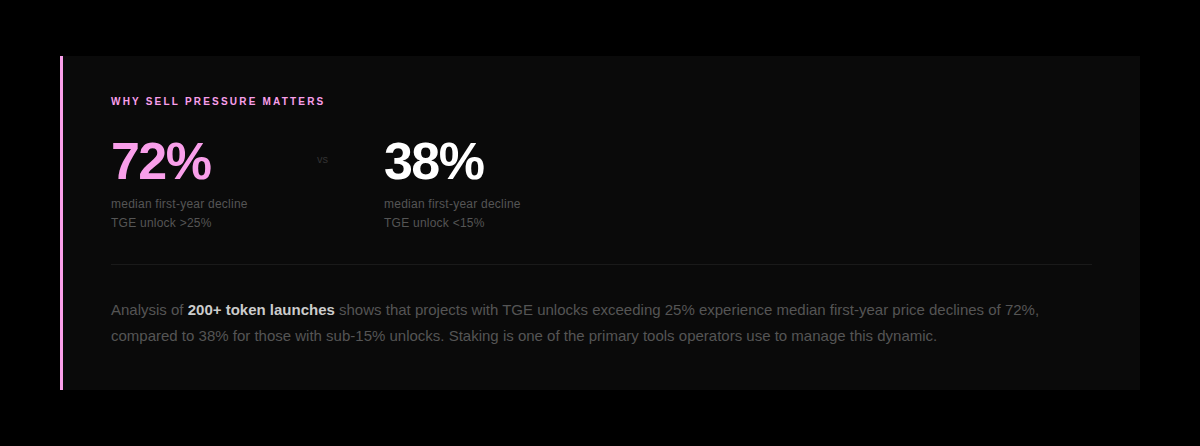
Why do projects use staking pools?
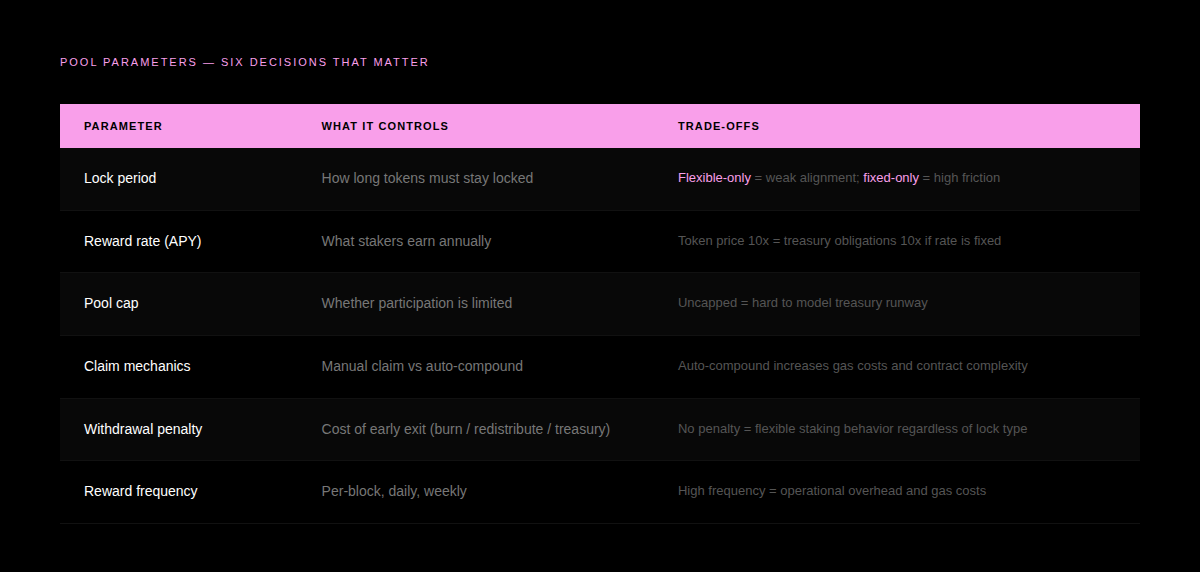
The parameters you set at launch become constraints you manage for months or years. Get them wrong and you are either burning treasury faster than planned, or you have set such conservative rates that no one participates.
The six decisions that matter most:
Common types of staking pools
Flexible staking
Stake and Unstake anytime with no minimum commitment. Lower rewards, but maximum accessibility for participants.
Fixed-term staking
Tokens locked for a predetermined period (30 days, 90 days, 1 year). Longer locks = higher rewards. No early withdrawal without penalty.
Tiered staking
Multiple pool options with different lock periods and rates. Users choose their preferred commitment level.
Permissioned vs permissionless
Permissionless pools are open to anyone. Permissioned pools restrict participation to specific groups (early investors, previous stakers, minimum holders).
How staking integrates with other token mechanisms
Claim-and-stake
The cleanest execution is a single transaction where a holder claims their allocation and immediately stakes it, without additional approval steps. This reduces friction and significantly increases participation rates.
The key requirement: your claiming and staking systems need to be designed together, not bolted together after the fact. A separate claim flow followed by a separate stake flow means two approval steps, two points of friction, and materially lower staking participation.
Staking vested tokens
Team members and investors with vested tokens can stake amounts that have already vested but are still waiting to unlock. Vesting establishes legal ownership; staking adds utility while tokens wait to unlock. Not every project enables this, but for teams with long vesting schedules, it keeps insiders engaged with the protocol.
Staking unlocked tokens
The most common case. Tokens that have been fully claimed and unlocked can be staked at any time. Applies to community allocations, liquidity tokens, and any distribution without an ongoing vesting schedule.
What it actually takes to manage staking pools
Treasury management and pool funding
Staking pools need to be funded with reward tokens. You need to decide:
- How much to allocate upfront
- When to refill the pool
- How to balance reward sustainability vs participant expectations
Under-fund the pool and it runs dry mid-program. Over-fund and you lock treasury tokens that could be used elsewhere.
Adjusting parameters over time
Market conditions change. A 50% APY that seemed reasonable at launch might become unsustainable if your token price increases 10x.
You need the ability to adjust reward rates, modify stake periods, or change caps without breaking existing stakes or redeploying contracts.
Handling real user behavior
Real users stake dust amounts. They retry failed transactions. They try to exit early and get confused by penalties they did not read clearly. They expect support when something breaks.
Projects that do not plan for edge cases end up with an overwhelming support queue. Common failure modes to design against:
- Dust amounts clogging the contract
- Users staking without reading the lock period
- Failed transactions with unclear error messages
- Participants attempting to game tiered mechanics
- Support requests from users who lost tokens to penalties
Reporting and visibility
You need to know:
- How many tokens are staked
- Current reward distribution rate
- Projected future obligations
Without visibility, you can't make informed decisions about pool management.
Most teams build custom scripts to parse blockchain data. This works until the contract gets updated or something breaks.
Staking at Magna
Most staking infrastructure is built for launch day. The announcement goes out, participation spikes, and everything looks fine. Then month three arrives. Reward rates that seemed reasonable are now straining the treasury. Participation has dropped and no one can explain why. Your team is parsing block explorer data to answer basic questions about how many tokens are staked. The infrastructure that was supposed to run itself is generating more operational work than anyone planned for.
Magna is built for that phase. The platform handles pool funding, parameter management, reporting, and user flows so your team is not building custom scripts or firefighting support tickets. The operational layer is covered. You focus on the token economics.
The NodePay case study shows what this looks like in practice. When NodePay launched its airdrop to over one million whitelisted wallets on Solana, the team needed a staking program they could launch quickly, keep fully branded, and trust at scale, without pulling engineers off their core product. Within two days, over 10% of the total token supply was staked across two configurable pools. At its peak, it became one of the largest staking deployments on Solana, with zero custom backend code and zero downtime.

The thing most teams miss
TThe announcement is not the hard part. The hard part is running a staking program in month six when participation has dropped, your reward rate is being questioned, and your treasury allocation is tighter than planned.
Successful programs are designed with that in mind from the start. Reward sustainability, parameter flexibility, clear reporting, and smooth user flows are not edge cases. They are core requirements.
Design for the long run.
Ready to structure your staking program? Schedule a demo at magna.so