
Minting a token feels like a technical event. You pick a chain, set a supply, deploy a contract, hit a button. Somewhere in a block explorer, a number appears next to a ticker. The token exists.
What most founders don’t fully appreciate until later is that every decision made in that moment is permanent. Chain selection. Token standard. Initial supply. Who holds the keys. The custody structure those keys live inside. You can migrate, reissue, and patch, but you cannot go back.
In 2025, 85% of tokens launched ended the year trading below their TGE valuation. The median token was down 71% from launch. That's not a market problem. The teams that avoided those outcomes weren't luckier. They were better coordinated.
Most teams don't recognize it as a coordination problem until they're already on the wrong side of it.
The moment most teams treat as technical
Last week, Kraken 360 published the first piece in our joint TGE Readiness Series. A 13-decision checklist mapping the full sequence of what needs to happen before a token goes live, in the order it needs to happen. The first two decisions on that list are entity and jurisdiction, and token economics and supply design.
This post goes deeper on both. Specifically on what the minting moment requires from the people responsible for each one, because minting isn’t just a technical event. It’s the moment where legal structure, custody infrastructure, tokenomics design, and exchange strategy all need to have been aligned. If they haven’t, you find out on the day. And that’s the worst possible time to find out.
The process involves several types of stakeholders: protocol developers, third-party custodians, investors, employees. All of whom need to be on the same page when preparing for the creation and custody of a new digital asset. That’s obvious in theory. What’s less often said is that in most launches, they aren’t.
Across the 160+ protocols Magna has supported, the teams that avoided the most painful minting moments weren’t better resourced or better advised. They just had the right people in the room earlier.
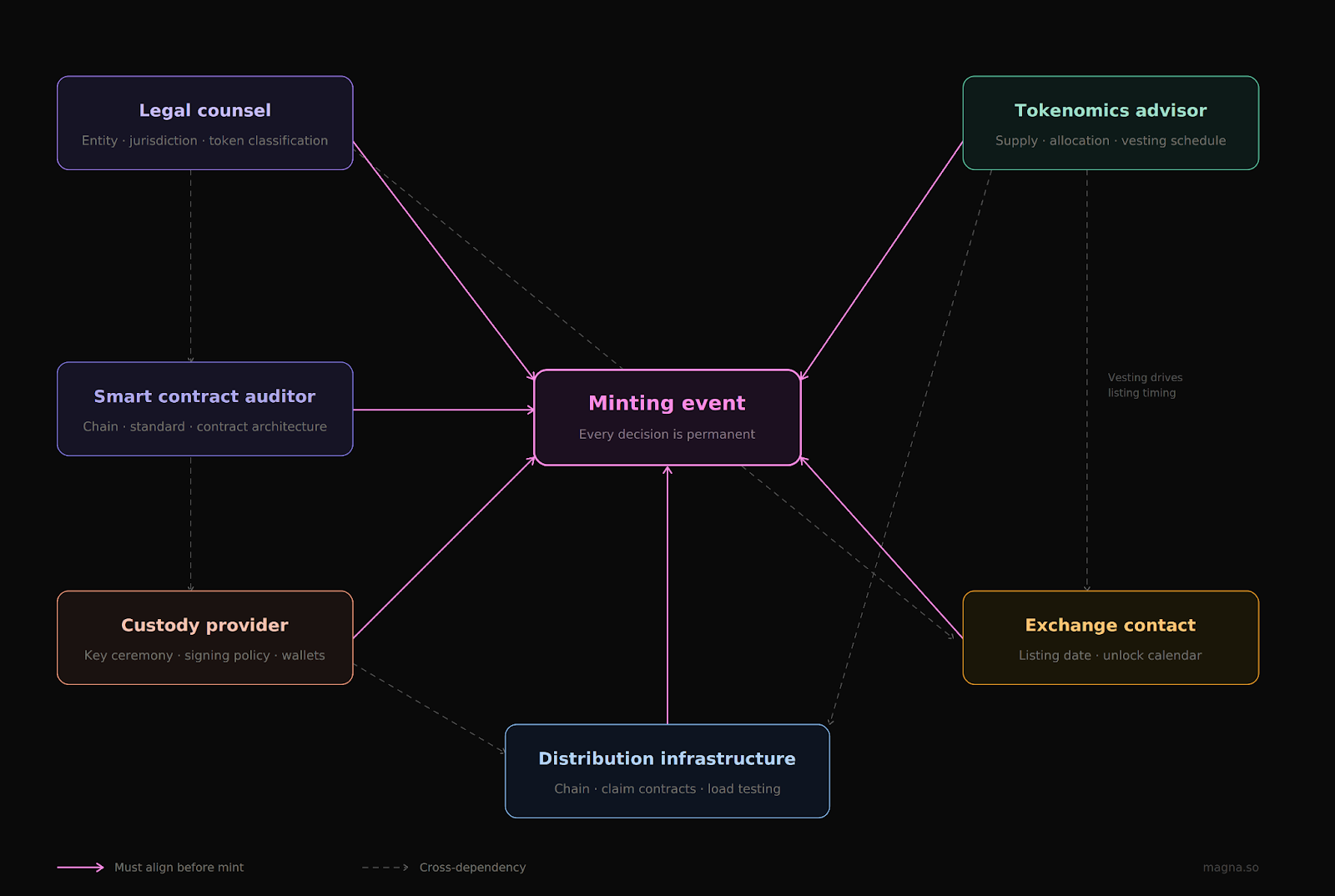
The six people who need to have aligned before minting
1. Legal counsel
This is the one everyone knows they need and the one who most often gets consulted too late. Legal counsel needs to have confirmed token classification, issuer entity, and jurisdiction before any minting discussion begins. The chain you mint on, the standard you use, the structure of your initial distribution, all of these have legal implications that vary by jurisdiction.
If legal hasn’t signed off on minting parameters before you deploy, you’re making legal decisions without a lawyer. That’s a different kind of risk than a buggy contract. We walked through the full sequence of legal and operational decisions that need to happen before a token goes live in our Token Launch Legal and Ops Prep Guide, and entity setup and jurisdiction are steps one and two for a reason.
2. Tokenomics advisor
Needs to have locked supply design, allocation table, and vesting schedule before minting, not after. For fixed-supply tokens, which remain the standard for most TGEs, initial supply is permanent. The allocation percentages set at mint determine every downstream decision: airdrop size, exchange allocations, market maker loan, treasury reserve. Minting against unfinished tokenomics means every subsequent vendor conversation starts from a shaky foundation.
The sequencing matters as much as the design. Teams that treat tokenomics as settled before approaching exchanges or market makers have materially cleaner launches than those who run those conversations in parallel. We wrote about this in our 2026 predictions piece, tokenomics is now economic architecture, and investors are underwriting tokens like businesses, testing assumptions and modelling downside cases. The bar has been raised. If your allocation table isn’t airtight before those conversations start, it shows.
3. Custody provider
Needs to be live and tested before tokens exist to put in it, not selected, not onboarded, not in progress. Key ceremonies completed. Signing policies documented. Wallet addresses confirmed.
Most founders underestimate custody until it becomes the blocker. You can have perfect tokenomics, audited contracts, and excited investors, but if your custody story doesn’t hold up, everything stalls. Across launches we’ve supported, the gap between “selected” and “live and tested” is consistently longer than teams expect. Integration timelines vary from weeks to months, and the earlier you start, the more options you have. The teams that begin custody onboarding at T-8 months have fundamentally different launch experiences than those who start at T-6 weeks.
4. Exchange contact
Needs to have seen your vesting schedule and initial supply breakdown before minting. The listing date and the unlock schedule are not independent decisions. If your exchange contact hasn’t seen the tokenomics table, you’re negotiating a listing date without the information they need to evaluate it.
This is one of the most consistent failure patterns in token launches: the team that negotiated the listing date has never spoken to the team that set the vesting schedule. More on that pattern below.
5. Distribution infrastructure provider
Needs to have confirmed chain compatibility, wallet support, and claim contract readiness before minting. If your distribution infrastructure isn’t compatible with your chosen chain and token standard, your claim portal doesn’t work on launch day.
Once tokens are minted, they must be stored and distributed through infrastructure that is already live and tested. The coordination between the minting event and the distribution layer is not an afterthought, it’s a prerequisite. That means the distribution provider needs to be in the room before the chain and token standard are finalized, not after.
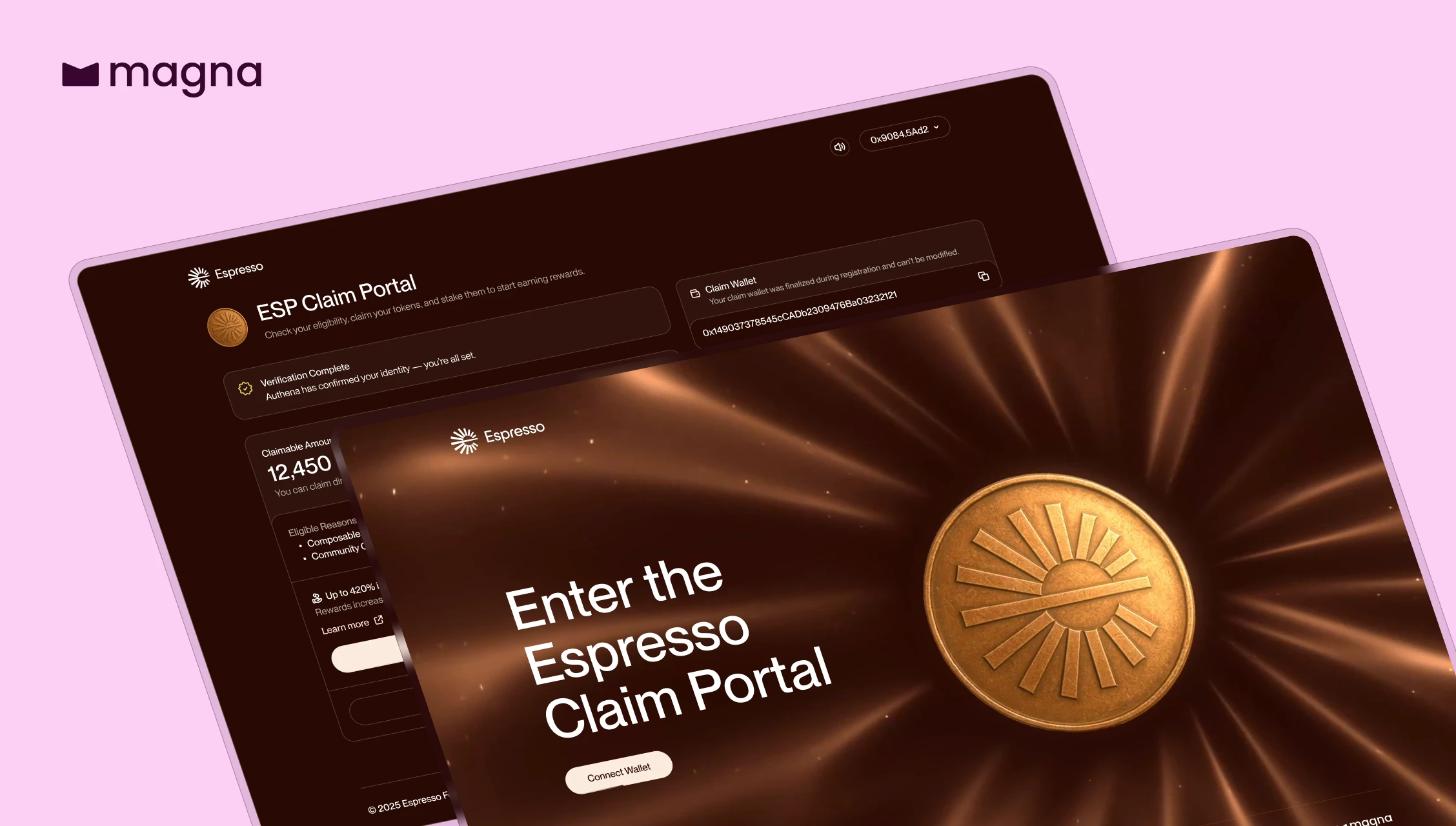
When Espresso launched its million-wallet airdrop in February 2026, the claim infrastructure absorbed 8.9 million submitted accounts and handled hundreds of claims per block at peak load, because the distribution layer had been confirmed well before mint. When Param Labs distributed to 500,000+ stakeholders with 12-month vesting for 50,000 recipients, the claimant list wasn’t finalized until 24 hours before launch, a timeline that’s only possible when the infrastructure is already live and waiting, not still being configured. In both cases, the distribution provider wasn’t brought in at the end. They were in the room from the start.
6. Smart contract auditor
Needs to have completed their review before minting, not alongside it. Audits take months to schedule, not days. If the auditor is still working when the minting decision is being made, the decision is being made without their input. The chain, the token standard, and the contract architecture all affect what the auditor is reviewing, which means the auditor needs to have been briefed on all three before they start, not handed a finished contract and asked to sign off quickly.
What happens when one of them isn’t there
The failure modes are predictable. They happen in variations of the same pattern across launches at every size.
The custody gap. The token gets minted on a chain that the custody provider’s onboarding timeline can’t accommodate before TGE. Custody setup starts at T-6 weeks instead of T-8 months. The key ceremony happens in a rush. Treasury operations on launch day are slower and more manual than they should be, in exactly the window where speed and precision matter most. We’ve seen this pattern across dozens of launches, it’s the single most common source of preventable launch-day stress.
The listing-unlock collision. The listing date gets set before anyone has shown the exchange the vesting schedule. The unlock cliff is already fixed. The listing date is already booked. A few months out, someone puts both dates in the same calendar for the first time and realises the first major unlock lands two weeks after listing. By then, neither date is easy to move.
The unmodeled sell pressure. The airdrop size, the exchange allocations, and the market maker loan get agreed in separate conversations, by separate teams, without a single model showing what day-one sell pressure actually looks like when you add them together. The people who needed to compare notes made their decisions in sequence rather than together.
The most documented version of this failure isn't about an airdrop. It's about a market maker agreement signed by one part of a team, opposed internally by legal counsel, and unknown to everyone else, that resulted in tens of millions of tokens hitting the market on launch day. The contract was real. The coordination wasn't.
When the pieces of a distribution are designed in isolation, the aggregate outcome is worse than any individual decision would suggest, and by the time someone builds the consolidated model, the numbers are already locked.
None of these are catastrophic on their own. All of them compound. And all of them start with the same root cause: the right people weren’t in the room before the minting decision was made.
The coordination problem
The six roles above are not new. Every team launching a token knows they need legal counsel, a custody provider, a tokenomics advisor, an exchange contact, and someone to run the distribution. The guides exist. The checklists exist.
Research surveying over 600 web3 founders and launch participants describes token launches as "high-stakes coordination systems" and notes that only a few get them right. The bottleneck isn't knowledge. It's execution across people who don't naturally talk to each other.
What doesn’t exist, in most launches, is a single moment where all six of those people are looking at the same model before minting happens. Legal has signed off on the structure but hasn’t seen the exchange’s listing requirements. The custody provider has been selected but hasn’t been briefed on the distribution timeline. The tokenomics advisor has finished the allocation table but hasn’t shared it with the market maker.
You can get all the technical decisions exactly right and still have a bad launch. The contract can be clean. The standard can be correct. The chain can be sensible. And still, if the people responsible for each component haven’t been in the same room before minting, the moment you treated as technical turns out to have been a coordination problem all along.
Most teams have some of them aligned. Find the gaps before you deploy.
This post is part of the TGE Readiness Series, a joint series from Magna and Kraken 360 on the moments that break token launches, and how to get them right. The full 13-decision checklist is on the Kraken 360 blog.